





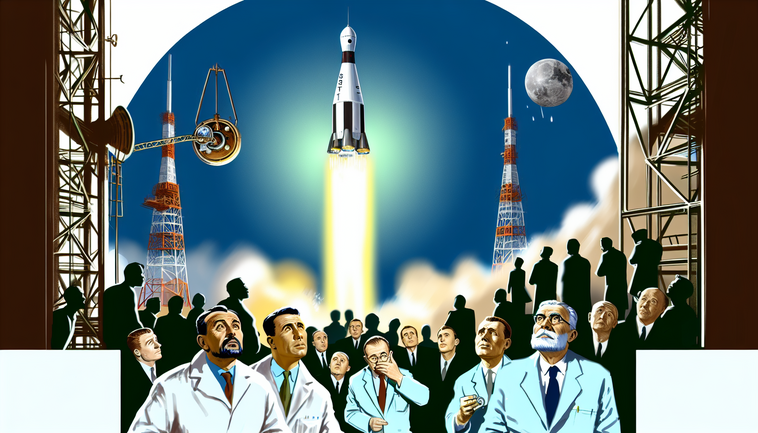
On This Day: How Sputnik Revolutionized Our View of the Cosmos
On October 4, 1957, humanity’s perception of the vast and mysterious cosmos underwent a seismic shift as the Soviet Union launched Sputnik 1. This seminal event marked the dawn of the Space Age, forever altering the trajectory of modern technology and international relations. It was a moment that encapsulated not only the ambitions of a nation but also the limitless possibilities that space exploration promised to humanity as a whole.
Sputnik 1, a gleaming metallic sphere armed with four striking antennae, was more than just a scientific breakthrough. It was a statement of geopolitical prowess, a bold assertion by the Soviet Union during a time when Cold War tensions were palpable. As the world’s first artificial satellite circled Earth, it sparked a fervent desire in the United States to match and surpass this unprecedented Soviet achievement, leading to the jump-start of the American space program.
The launch had an impact far beyond political rivalries. It ignited a new era of scientific inquiry, setting the stage for rapid advancements in satellite technology that we often take for granted today. The capabilities accelerated by this tiny satellite have led to monumental developments in telecommunications, meteorology, and global positioning systems, embedding space technology intricately into the weave of modern life.
Reflecting on Sputnik’s legacy, it’s fascinating to consider how a mere 58-centimeter sphere propelled dreams of interstellar exploration. This event highlighted not just the potential for discovery but also raised questions about our responsibilities beyond Earth. The door to space exploration didn’t just open possibilities; it also presented challenges regarding international cooperation and ethical considerations in an environment far removed from sovereign borders.
From Sputnik’s beep echoing across continents to the elaborate Mars rover missions today, human curiosity and ambition have continued to chart a course through the stars. The International Space Station, for instance, stands as a testament to the collaborative spirit ignited by those early days of space rivalry. Different nations, once pitted against each other in the race to space, now engage in shared scientific missions for the benefit of all humankind.
For those of us today, living in an age where space tourism is becoming a reality, it’s crucial to appreciate the origin of this journey—the seemingly humble Sputnik which broke free from our atmosphere’s grasp over sixty years ago. It reminds us that space exploration is not just about technological mastery but also a persistent drive to breach barriers and push beyond what we deem possible.
As we look to the future, the lessons from Sputnik teach us the power of human ingenuity and international unity. We are reminded that what was once an unimaginable frontier is now an extension of our collective consciousness. Sputnik’s legacy is a reminder of the extraordinary potential we harness when we look towards the stars, not just as separate nations, but as a unified humanity aiming for progress beyond the horizon.